
Rowing
The stages of a stroke, the parts of a boat, and my own experience as a novice rower

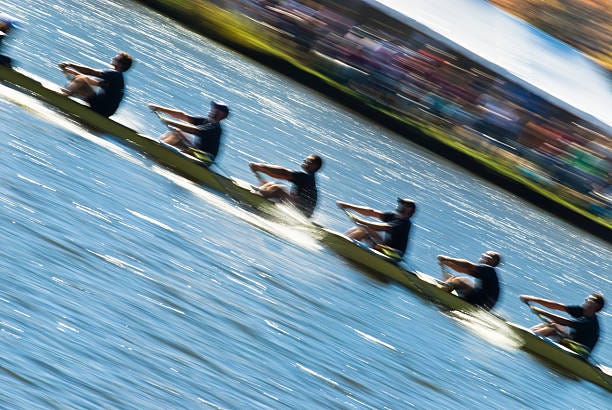
Back in late August of 2023, I joined a rowing club in the San Francisco Bay Area called Norcal Crew. Given how rowing itself is not commonly known to many, I decided to detract from my more usual blog topics and write one on rowing; specifically its fundamental stages, the parts of a boat, and my own experiences.
The stages of a stroke
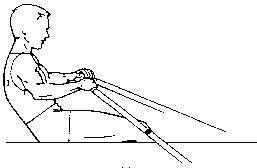
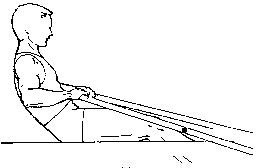
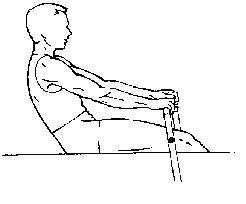
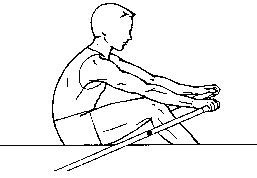
The stroke itself is split into four main stages; the catch, drive, finish, and recovery.
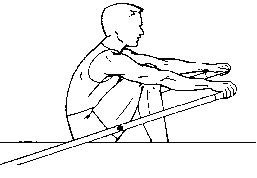
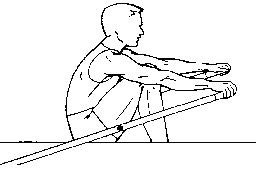
The catch is the placing of the oars into the water and the final preparation of the body for the drive.
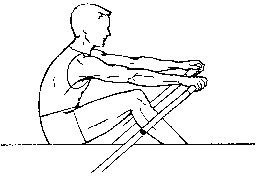
The drive is the driving(hence the name) portion of the stroke and thus is the propulsion stage. It starts with a pushing of the legs, a body swing (once the legs are at their full extension), and a pulling of the arms(once the body has leaned back).
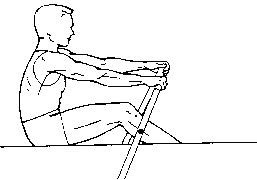
The finish is when you have reached the end of the drive and have to take your blades out of the water to move back into the catch.
The recovery is the controlled moving of your body back into the catch to take the next stroke. It starts with an extension of the arms, a rocking back of the body to lean in front, and ends with a drawing in of the legs.
Each stage must flow seamlessly to take an efficient stroke. Below is a series of images that depict how the stroke looks like.
The parts of a boat
There are many intricate parts to a racing boat, and all of these work in tandem when rowing.
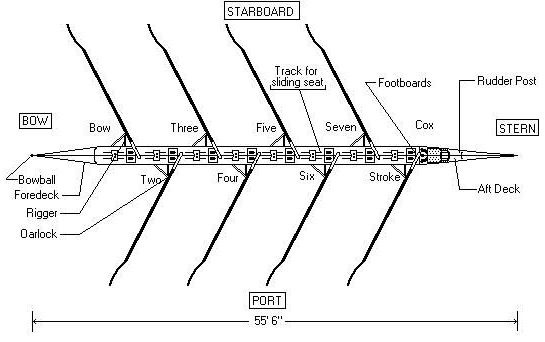
The racing shell is the boat itself. It is narrow and very long to ensure that it goes as fast as possible. Unfortunately, as a consequence of such a narrow hull proportionally to its length, it requires a great deal of skill and practice to keep one on an even level.
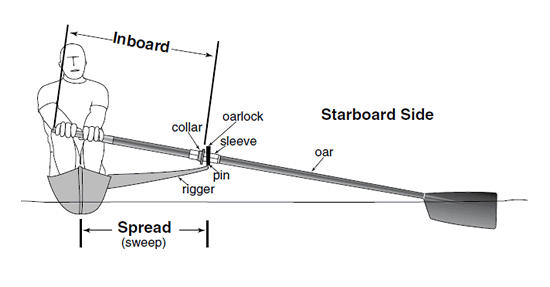
The oarlocks are the insertion points for the oars to go into.
The oar-collars are small circular extensions from the oars which make sure the oars don’t slip through the oarlocks.
The oar-sleeves are protection for the part of the oar that goes through the oarlock.
The pin is the swiveling point to which the oarlock is attached.
The riggers are the structures holding the oarlocks. There is one per person(sweeping, where everyone has one oar), or two per person(sculling, where everyone has two oars).
The oars are the main “levers” a rower uses when rowing. These go into the water and the rower uses them as a lever to propel the boat forward.
The foot-stretchers are the stretchers where the rower’s feet are. Rowers push off these with their legs during a stroke.
The seat is a seat (surprisingly) that is attached to a set of wheels on a track. This allows the seat to move freely from the rest of the boat and allows the rower to use their legs in the first place.
Two diagrams showcasing some of the aforementioned equipment:
My own experience
Looking at videos of elite rowing, one would see the fluidity and smoothness of the rowers and mistake rowing to be easy. However, when I first started rowing, I quickly learned that nothing could be further from the truth. The stages of a rowing stroke require a surprising amount of time and practice to be able to flow smoothly. Coupled with the breathtaking physiological requirements of rowing and the incredible precision you need to stay in time with other rowers in your boat(unless you are in a single, where there is only one rower), I started to rapidly develop both physically and mentally. I became the strongest and fittest I’ve ever been and have found it much easier to stay even-tempered, learn from mistakes, recover quickly with grace, and persevere.
I am glad to say that I have gained many good friends on the team, as we all went through the same grueling training and faced the same tests together. When it all came down to the USA Youth Nationals this year in early June, we managed to finish as the 3rd fastest team in our event in the country as a result of the hard work we have done and our mutual respect. Looking back, I am very glad I stuck with it and I am already looking forward to the next season!
Conclusion
Rowing is an undertaking of extreme beauty preceded by extreme punishment. It changes you in ways you could only wish for earlier and gives you lifelong relationships.
Thank you all for reading, and I will see you soon! Bye!
Very nice Abinav
Explained very well about rowing
Keep up the enthusiasm